
Static UPS
- Energy store
- Batteries, lead-acid or lithium-ion
- Principle
- Usually online double conversion: in normal operation the inverter feeds the load
- Build
- Modular cabinets
UPS power for data center operators, developers and general contractors across Germany.
An uninterruptible power supply (UPS) keeps the IT load running when the grid fails and carries it until the generator has taken over.
It also filters the supply: in double-conversion mode, grid disturbances are kept from the servers.
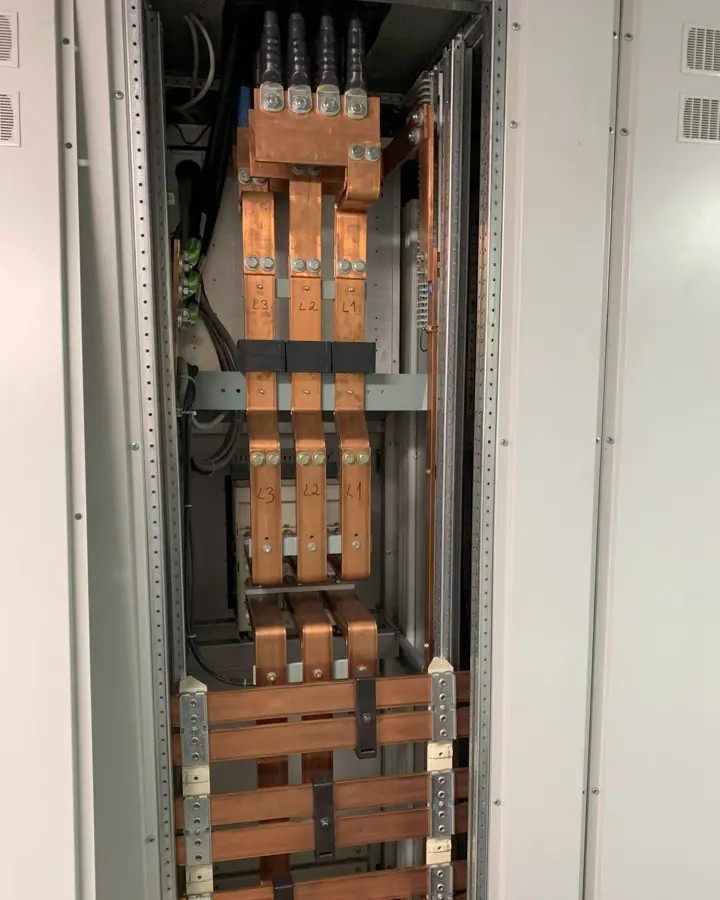
Experience with all major manufacturers. Riello UPS is among our partners and suppliers.
| System | Its job | Our work |
|---|---|---|
| UPS systems | Bridge grid failures, filter the supply | Installation, fault repair down to the battery modules |
| Static transfer switches (STS) | Switch the load between two sources | Installation |
| Busbar systems | Carry power along the rack rows | Installation |
| Generators | Take over in long outages | Installation |
| BMS connection | Reports UPS and STS alarms | Planning and integration |
We design and install 2N and 2N+1 power distribution.
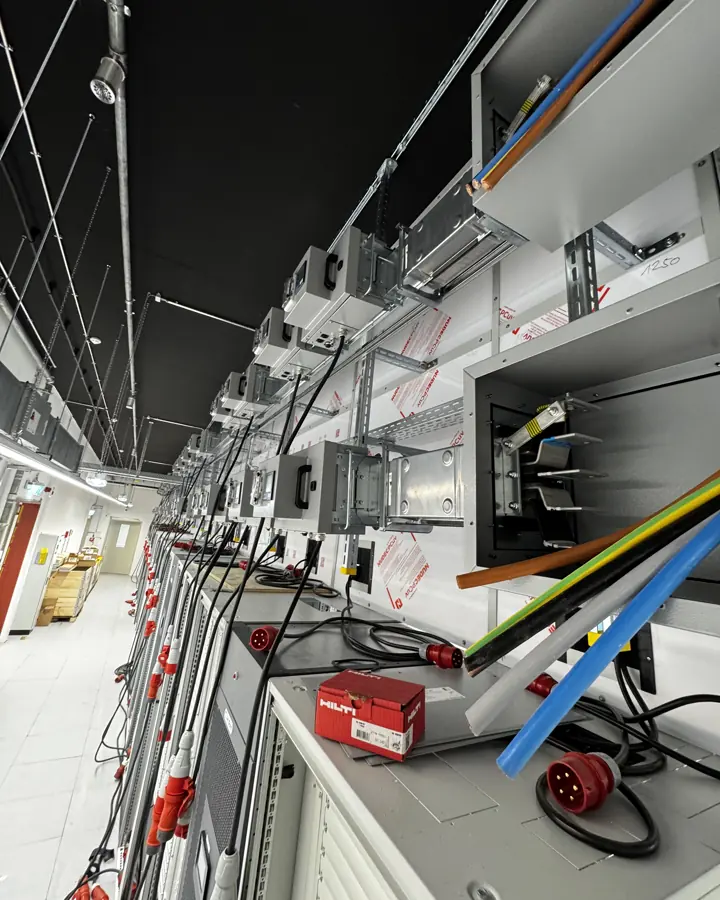
Power calculation, cable planning and the redundancy concept.
UPS, STS and busbars as part of a turnkey data hall.
States such as UPS on battery reach the operator.
Fault clearance and repair after go-live.
A static UPS stores energy in batteries and feeds the load through power electronics. A rotary UPS stores it in a flywheel and works with a motor generator, often coupled to a diesel engine. Both bridge the time until the backup supply has taken over.
The UPS rectifies the grid supply to direct current, and an inverter turns it back into clean alternating current. In normal operation the load runs on the inverter, so a grid failure needs no switchover: the batteries simply take over the DC link.
N is the capacity the load needs. N+1 adds one spare unit, so one unit can fail without loss of supply. 2N doubles the whole supply path: two independent systems, A and B, each able to carry the full load. GDS Datacenter Solutions designs and installs redundant power distribution such as 2N and 2N+1.
When the grid fails, the UPS carries the load from its batteries or flywheel while the generator starts. Once the generator runs, it supplies the UPS. Static transfer switches move loads with a single power supply between the A and B feeds, and busbars carry the power along the rack rows to the tap-off boxes. A connected BMS reports the state of each of them.
The principle is the same. An industrial UPS is often built for harsh surroundings and for loads such as motors and process controls; a data center UPS supplies IT equipment, usually in a redundant configuration. GDS Datacenter Solutions installs UPS systems in data centers.
Our technicians have years of experience with systems from all major manufacturers and power classes. Riello UPS is among our partners and suppliers.
We clear the fault and repair or replace defective components, down to the UPS battery modules. Call Marcel Gerull on +49 151 24475314.
Send us the load, the redundancy concept and the schedule.