
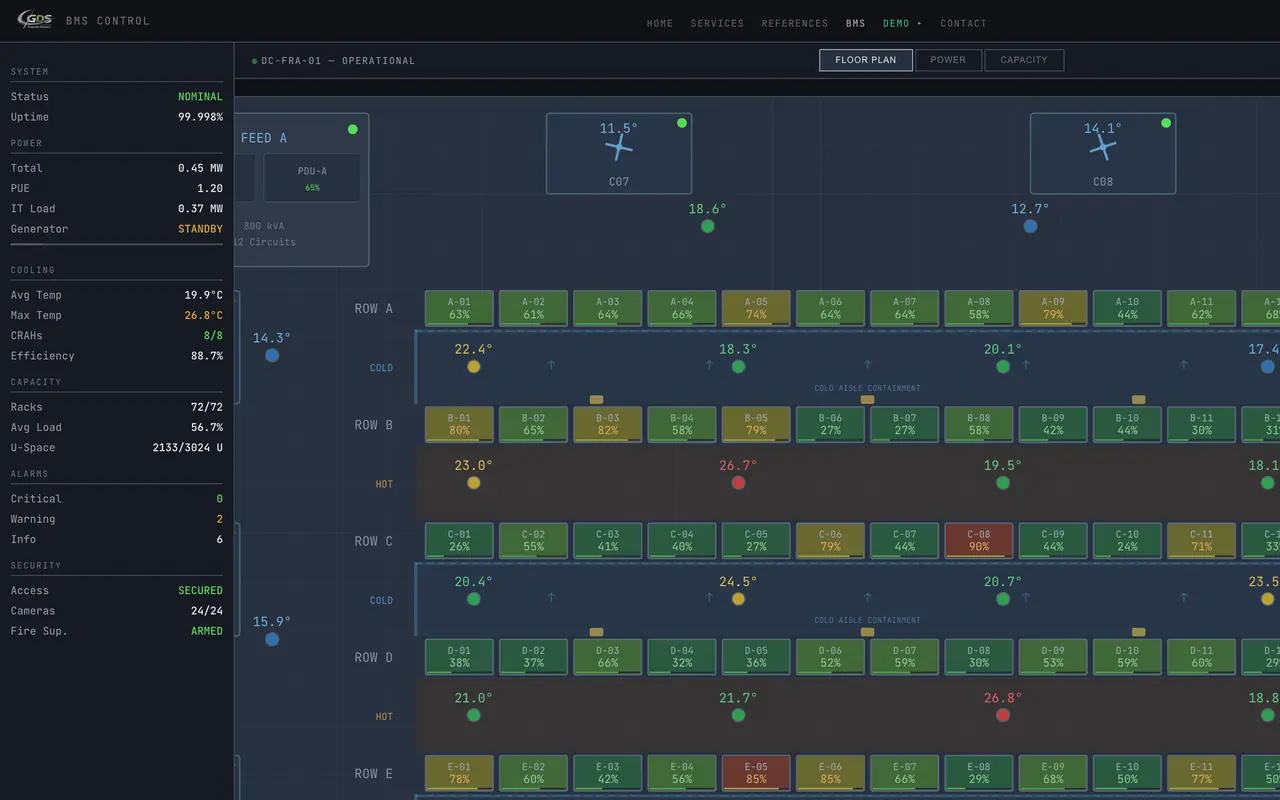
BMS Demo 1
Fast HTML preview with floor plan, power view and capacity simulation, for presentations.
Open BMS Demo 1Power supply, cooling and sensors in one plant view, developed in house.
A building management system (BMS) monitors the infrastructure a data center’s IT depends on: power paths from transformer to rack PDU, UPS, generators, cooling, temperature, humidity, leakage and fire alarm states. It records measurements, raises alarms by priority and keeps a traceable history for the operations team.
Not to be confused with a battery management system, which monitors the cells of a UPS battery.
| System | Purpose | Data sources | Typical users |
|---|---|---|---|
| BMSBuilding management system | Monitor building services, raise alarms | Power, cooling, climate, leakage, fire alarms | Operations team |
| BASBuilding automation system | Control HVAC and lighting, often called BMS | Controllers, field devices | Building technicians |
| DCIMData center infrastructure management | Plan rack space, power and cooling | Assets, rack PDUs, IT load | Capacity planners |
| EPMSElectrical power monitoring system | Analyse energy and power quality | Meters, protection relays, switchgear | Electrical engineers |
Project-specific integration options, agreed with your team for each installation:
Plant overview, protocols, data-point lists, measurement locations and alarm routes.
Source, unit, interval and plausibility limits for every data point.
Thresholds, delays, priorities and escalation routes, agreed with your team.
Supply lost, UPS on battery, cooling fault: the operator approves each test.
Fast HTML preview with floor plan, power view and capacity simulation, for presentations.
Open BMS Demo 1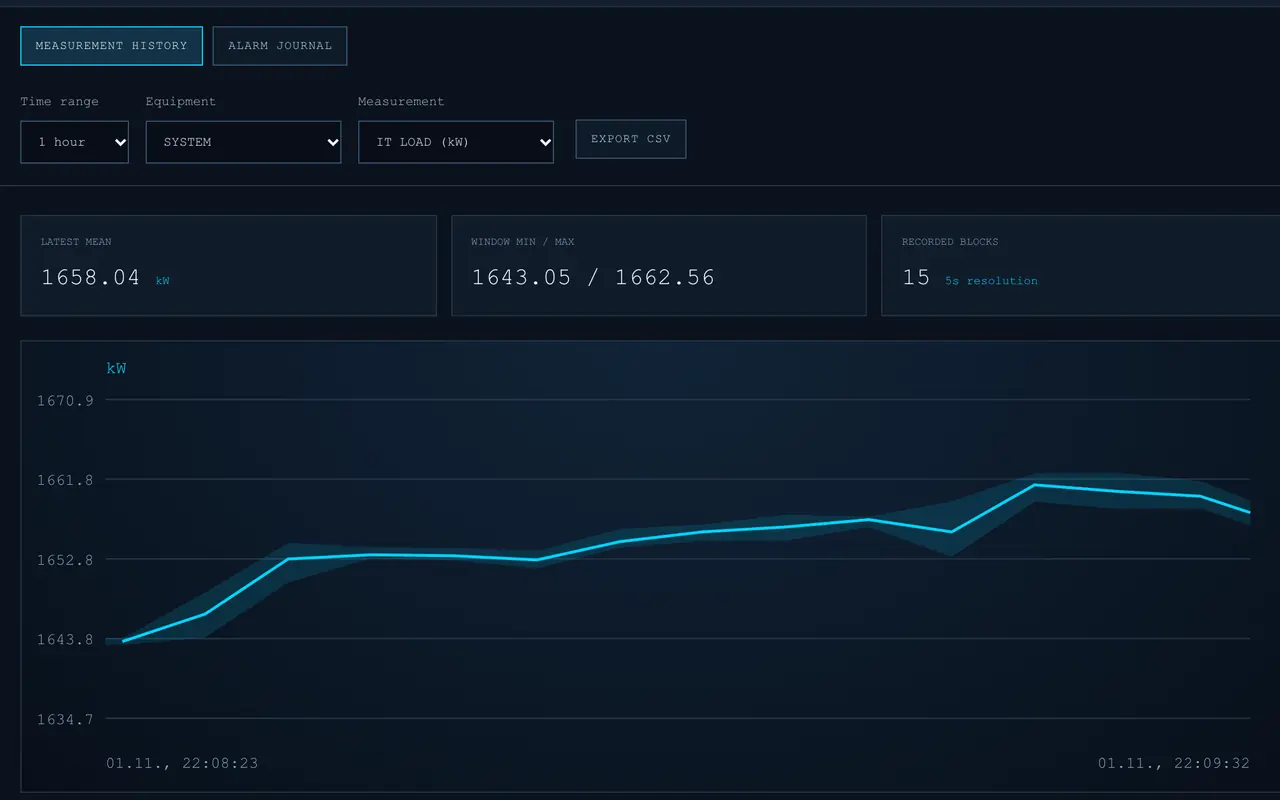
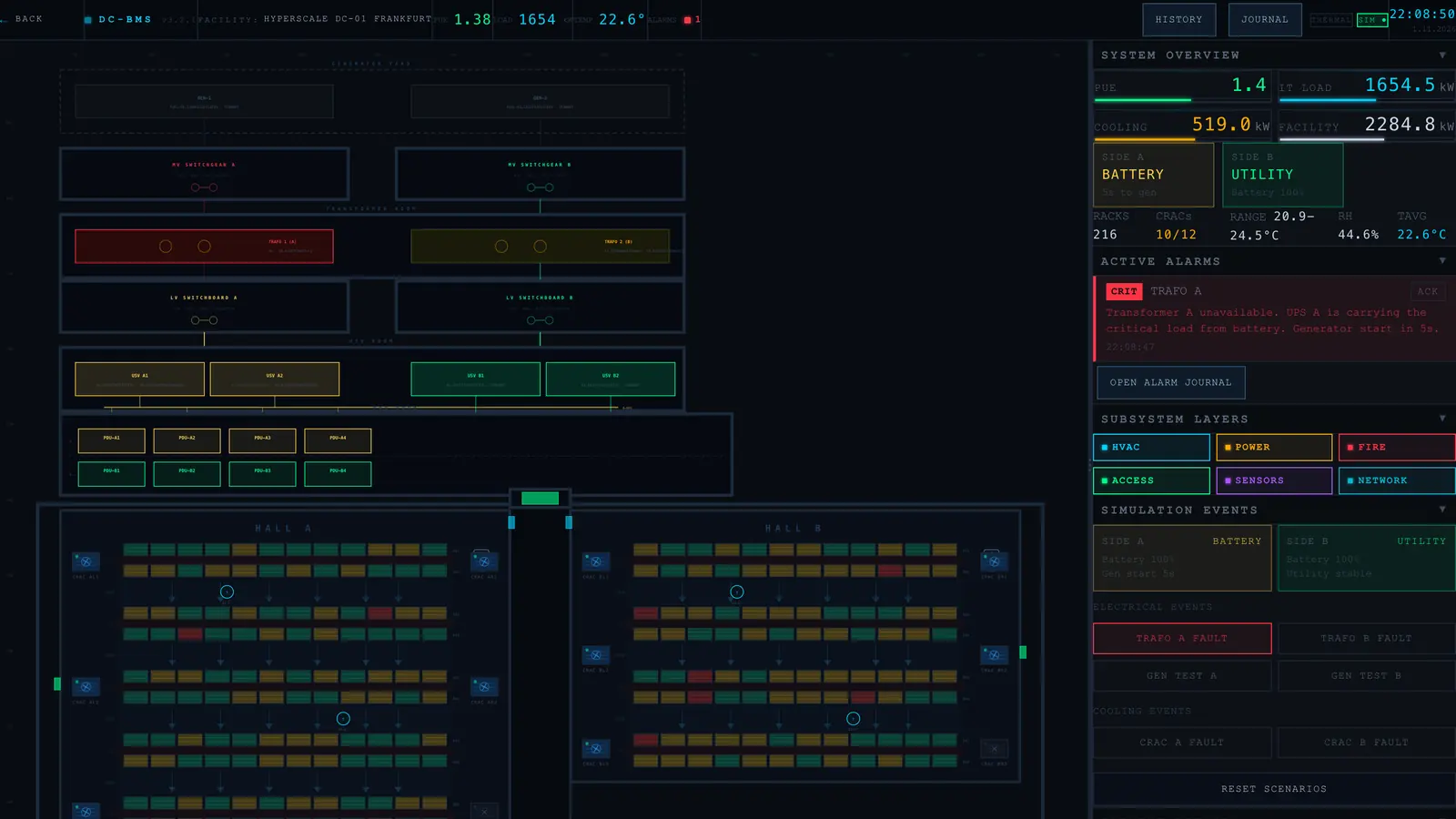
Live simulation in React and SVG: hall model, power paths, alarms and history.
Open BMS Demo 2GDS Datacenter Solutions combines in-house BMS development with electrical engineering and infrastructure services for data centers.
Mainly the number of data points and field devices, the interfaces to existing plants and their protocols, the alarm matrix and notification paths, the historian, roles and retention, and the scope of the acceptance tests. We define these together when we scope the pilot.
Through the interfaces your plant already offers, such as BACnet, Modbus or SNMP: these are project-specific integration options. We start from your protocols and data-point lists and agree each connection in the pilot scope. No plant is connected to the public demo.
No, we work across manufacturers. Real field devices are selected for each plant, interface and test requirement, including range, accuracy, calibration and certificates. The device categories on this page are project components, not a released GDS Datacenter Solutions hardware catalogue.
A BMS watches the building services: power path, cooling, climate, leakage and fire alarm states, with alarms and history. DCIM manages the IT side: rack space, power and cooling capacity, assets and connections. Many operators link the two; we agree existing DCIM connections for each project.
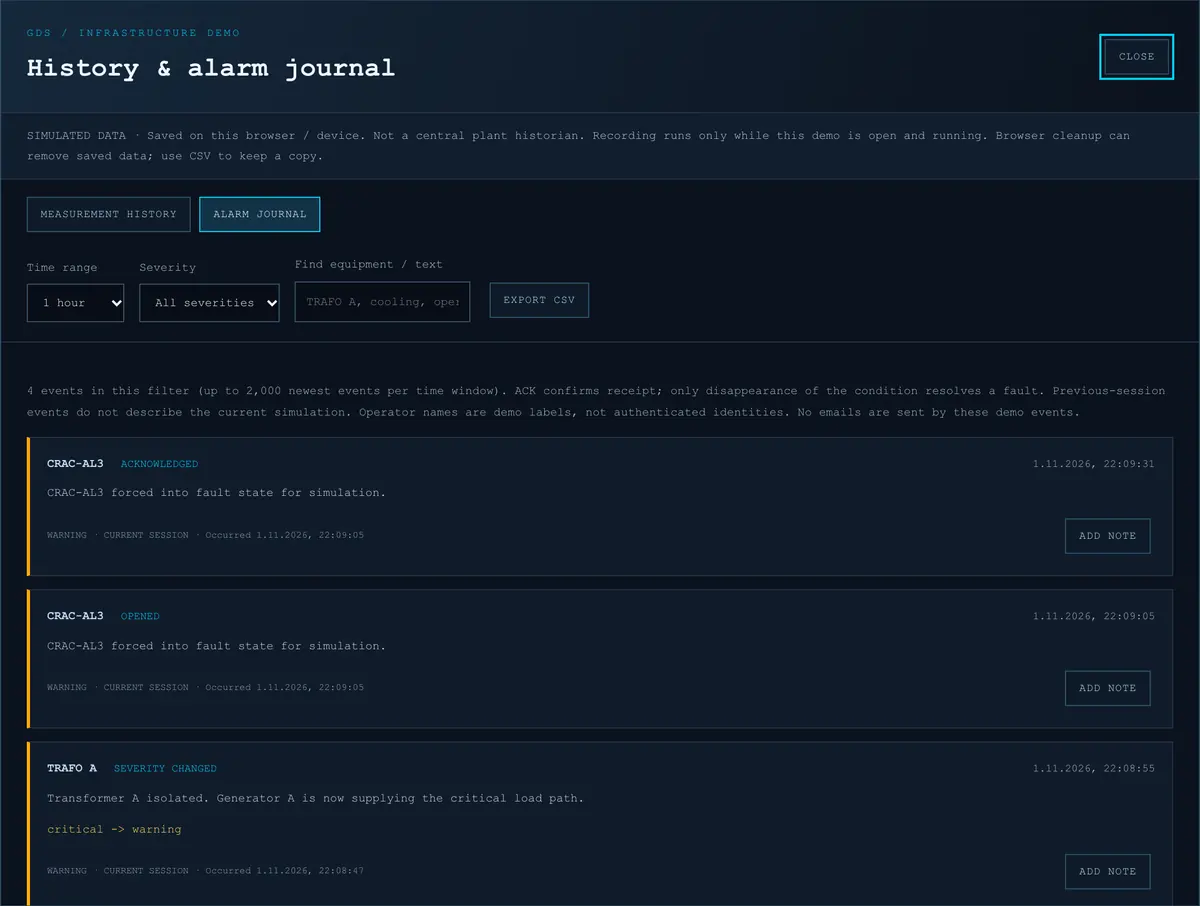
In the demo, history stays local in your browser (IndexedDB), and operator names are labels, not authenticated users. A real plant needs an agreed data-point list, tested device connections, secure user roles, central storage and backups; we agree access rights, the historian and retention with your team.
During transformer loss, the team can trace the switch to UPS battery and generator supply. Acknowledgement records receipt, not resolution. Measurement trends support a shared root-cause investigation.
Whether new installation or migration: we’ll advise you without obligation and find the right solution for your data center.